
Digital Marketing

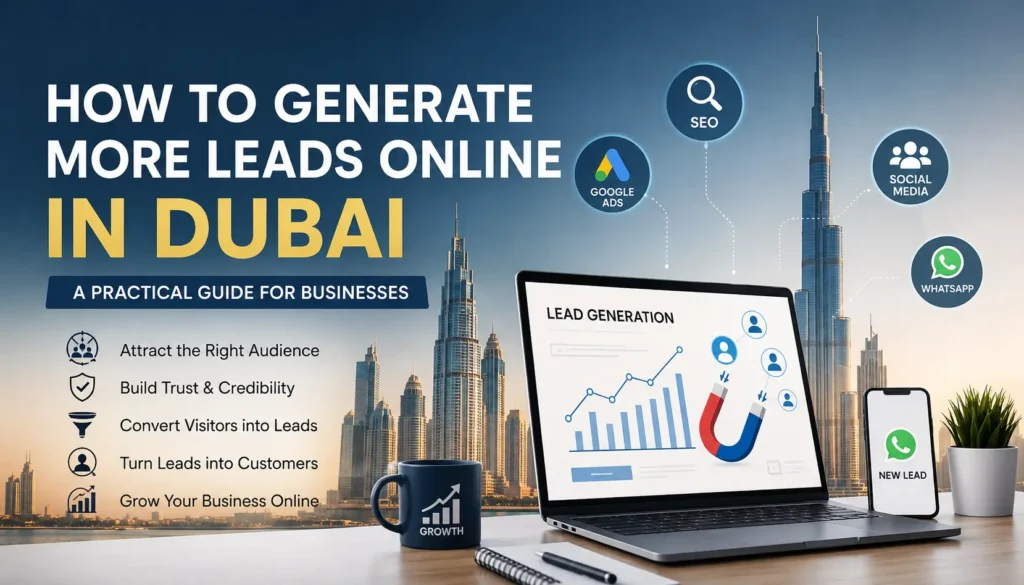
How to Generate More Leads Online in Dubai
Digital Marketing

How to Generate More Leads Online in Dubai

Getting website visitors is easy. Getting the right people to enquire, call, message, or request a quotation is much harder. For businesses in Dubai, online lead generation has become an important part of building a predictable sales pipeline. Whether you operate a real estate company, consultancy, clinic, e-commerce brand, interior design business, or professional service, your potential customers are already researching businesses online before making a decision. The challenge is not simply getting more traffic. The real challenge is turning that traffic into qualified leads and eventually paying customers. A successful lead generation strategy combines search visibility, paid advertising, compelling offers, conversion-focused landing pages, social media, and fast follow-up. More importantly, these elements need to work together rather than operate as separate marketing activities. What Is Online Lead Generation? Online lead generation is the process of attracting potential customers through digital channels and encouraging them to take a meaningful action. Depending on your business, that action could be: A visitor who reads one of your blog posts is not necessarily a lead. Someone who reads the article and then contacts your business because they are interested in your service is much closer to becoming a customer. That distinction is important because lead generation should ultimately be measured by business outcomes, not traffic alone. Why Generating Leads in Dubai Can Be Challenging Dubai offers enormous opportunities for businesses, but it is also a highly competitive market. A potential customer can often find several companies offering similar services within a few minutes of searching online. This means simply having a website is no longer enough. Your business needs to answer three questions quickly: Why should someone find you? Why should they trust you? Why should they contact you now? Your digital marketing strategy should be designed around those questions. For example, a property company may compete with hundreds of other agencies. A dental clinic may compete with numerous clinics targeting the same neighbourhoods. A B2B service provider may be competing against both local companies and international firms. The businesses that consistently generate enquiries are usually the ones that make their value clear and remove unnecessary friction from the buying process. 1. Start With a Clear Definition of Your Ideal Customer Before spending money on advertising or publishing dozens of blog posts, define exactly who you want to attract. Consider: For example, “people in Dubai” is far too broad for most campaigns. A better audience might be: Business owners in Dubai looking for an experienced digital marketing professional to generate qualified enquiries through SEO and paid advertising. The more precisely you understand the customer, the easier it becomes to create relevant ads, landing pages and content. 2. Use SEO to Capture People Already Searching Search engine optimisation can become one of your most valuable long-term sources of leads. Someone searching Google for a service is often demonstrating a stronger commercial intention than someone who happens to see an advertisement while scrolling through social media. Instead of creating content around generic topics, build pages and articles around questions and problems your potential customers actually have. For a Dubai business, this could include topics such as: The goal isn’t to insert “Dubai” into every sentence. The goal is to demonstrate that you understand the specific needs, competition and buying behaviour of businesses operating in the market. Build content around different stages of the buying journey Not everyone searching Google is ready to purchase. Someone searching: “What is SEO?” may simply be researching. Someone searching: “SEO expert Dubai pricing” is demonstrating considerably stronger commercial intent. Your content strategy should address both audiences while giving greater priority to searches that can eventually generate enquiries. 3. Create Landing Pages That Are Designed to Convert Getting someone to your website is only half the job. The next question is: What happens when they arrive? A common mistake is sending every advertising visitor to the homepage. A dedicated landing page can often provide a much clearer journey. For example, if you are advertising Google Ads services, the visitor should ideally arrive on a page specifically explaining your Google Ads expertise rather than having to search through the entire website. A strong landing page should communicate: Your call-to-action should also be obvious. Instead of making visitors search for a contact button, use straightforward actions such as: Request a Consultation Get a Marketing Strategy Discuss Your Business Send an Enquiry The best CTA depends on the customer’s stage in the buying process. 4. Use Google Ads to Capture High-Intent Demand SEO is valuable, but it takes time to build. Google Ads can help businesses appear in front of people who are already searching for specific products or services. For example, a business selling a professional service in Dubai could target searches related to its exact service rather than paying to reach a broad audience. The advantage is intent. Someone actively searching for a solution has already identified a problem. However, paid search only works efficiently when the entire journey is aligned: Search → Advertisement → Landing Page → Enquiry → Follow-Up → Sale If one part of this process is weak, increasing the advertising budget may simply increase the number of poor-quality enquiries or wasted clicks. 5. Don’t Ignore Meta Ads Google captures existing demand. Facebook and Instagram can help you create and stimulate demand. This makes Meta advertising particularly useful for businesses where visual presentation, lifestyle, emotion or discovery influences purchasing decisions. Examples include: Rather than promoting the company with a generic “Contact Us” advertisement, think about what would actually motivate someone to respond. Your offer could be: The advertisement should give people a reason to take the next step. 6. Make WhatsApp Part of Your Lead Strategy For many Dubai businesses, the distance between interest and conversation can be shortened considerably when customers have an easy way to contact the business. That’s why WhatsApp can be an effective part of a lead-generation funnel. Instead of forcing someone to complete a long form, you can give them a direct conversation option. For example: Interested in improving
How I Generate Leads Through Digital Marketing
Digital Marketing

How I Generate Leads Through Digital Marketing

Generating leads is not simply about getting more people to click on an advertisement. For me, effective lead generation starts with understanding who the right customer is, what they are looking for, and what needs to happen between the first interaction and the final conversion. As a digital marketing expert in Dubai, I use a combination of paid advertising, SEO, audience targeting, landing pages, creative testing, tracking and conversion optimization to build lead-generation campaigns that focus on quality as well as volume. Understanding the Right Audience Before launching a campaign, I first look at the target audience. Who are they? What are they interested in? What problem are they trying to solve? Where do they spend time online? What would make them take action? For example, a real estate campaign targeting international property buyers requires a very different strategy from a campaign targeting local businesses or e-commerce customers. Audience research helps determine the right platforms, messaging, creative direction and campaign structure. Choosing the Right Marketing Channel Not every business needs to use every advertising platform. I typically consider channels such as: The right channel depends on the audience and the buying journey. Google Ads can be effective when people are already searching for a product or service. Meta Ads can be powerful for reaching specific audiences through visual creatives, interests, behaviours and retargeting. LinkedIn can be valuable for B2B campaigns and professional audiences. SEO helps businesses attract people who are actively searching for relevant information, products or services. The objective is not to use the most platforms. It is to use the platforms that can reach the right audience efficiently. Creating the Right Offer A campaign can have excellent targeting and still generate poor leads if the offer is unclear. Before launching an advertisement, I ask: Why should someone respond to this ad? The offer needs to communicate value quickly. Depending on the campaign, this could be: The offer should match the audience’s level of intent. Someone who has never heard of a brand usually needs different messaging from someone who has already visited the website or interacted with previous advertisements. Building Creative That Gets Attention People scroll quickly. The first few seconds of an advertisement can determine whether someone continues looking or moves on. I focus on creating advertising creatives that communicate the main message quickly without overwhelming the audience with unnecessary information. Depending on the campaign, I test: The goal isn’t simply to create something that looks good. The creative needs to attract attention and encourage the right person to take the next step. Optimizing the Lead Form or Landing Page Getting someone to click is only part of the process. The next step is converting that interest into a lead. For lead-generation campaigns, I look at factors such as: A form that asks for too much information can reduce conversions. However, a form that asks for almost nothing can generate a large number of low-quality leads. That’s why I focus on finding the right balance between conversion rate and lead quality. Measuring Lead Quality, Not Just Lead Volume One of the biggest mistakes in lead generation is judging a campaign only by the number of leads. For example: Campaign A: 100 leads at a low costCampaign B: 40 leads at a higher cost At first glance, Campaign A looks better. But if only 2 of those 100 leads are qualified while 15 of Campaign B’s 40 leads become genuine sales opportunities, Campaign B may actually be the stronger campaign. That’s why I look beyond basic metrics such as clicks and cost per lead. Depending on the campaign, I monitor: The closer marketing data is connected to actual business outcomes, the better decisions I can make. Testing and Optimization I don’t expect the first campaign setup to be perfect. Digital marketing requires continuous testing. I test different combinations of: Audience + Creative + Message + Offer + Landing Experience When the data shows that one approach is outperforming another, I allocate more attention and budget toward what is working. When something isn’t performing, I investigate why. Is the audience wrong? Is the creative weak? Is the offer unclear? Is the landing page causing people to drop off? Are the leads coming in but failing to qualify? This process turns campaign management into an ongoing optimization cycle rather than a one-time setup. Retargeting Interested Audiences Not everyone converts during their first interaction with a brand. Someone might: These interactions create valuable audiences for retargeting. Instead of showing the same message repeatedly, I can use different messaging based on where someone is in the customer journey. For example, someone who has already visited a landing page may need a stronger call to action than someone who has only seen an introductory advertisement. Connecting Marketing With Sales Lead generation doesn’t stop when a form is submitted. The sales process matters. A campaign can generate hundreds of leads, but if those leads aren’t contacted quickly or aren’t properly followed up, the marketing investment can be wasted. That’s why I look at the connection between: Advertisement → Lead → CRM → Follow-up → Qualified Opportunity → Sale Where possible, I use CRM and tracking systems to understand what happens after the lead is generated. This creates a much clearer picture of which campaigns are actually contributing to business growth. My Approach to Lead Generation My approach is based on one simple principle: Don’t optimize only for more leads. Optimize for better opportunities. A successful lead-generation campaign should combine: The right audience↓The right message↓The right creative↓The right offer↓A frictionless conversion process↓Fast and effective follow-up↓Continuous optimization This is how I approach digital marketing campaigns across different industries and markets. Final Thoughts Digital marketing lead generation is not about finding one perfect advertisement and leaving it running indefinitely. It is a continuous process of research, testing, measurement and optimization. The platforms, audiences and creative formats may change, but the fundamental objective remains the same: Reach the right people, give them a compelling reason to take

Freelance Digital Marketer vs Agency in Dubai
Digital Marketing

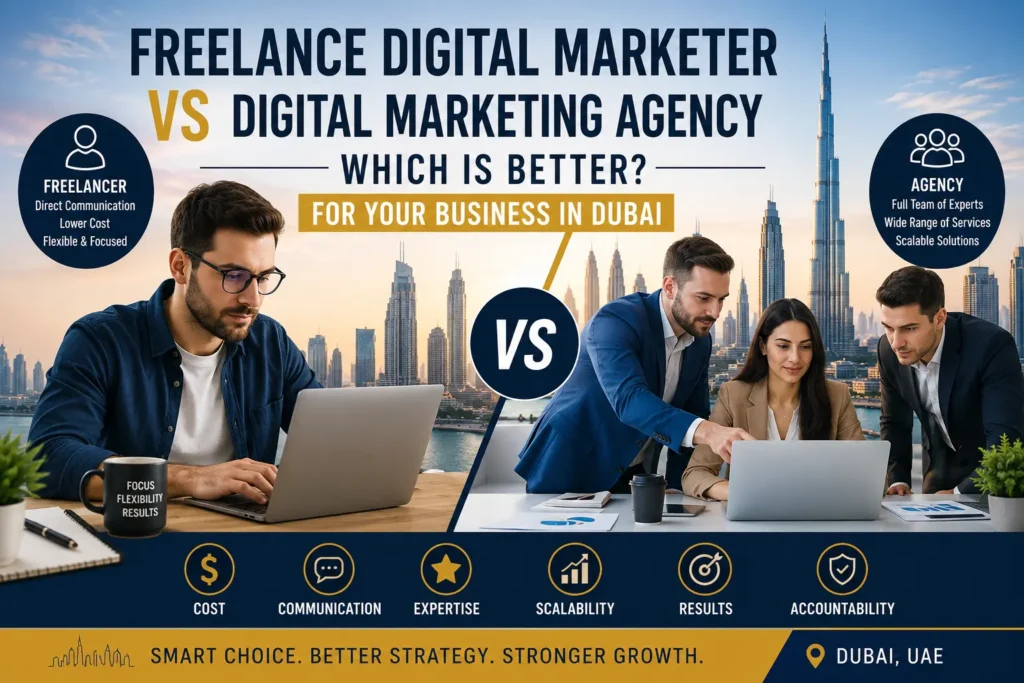
Freelance Digital Marketer vs Digital Marketing Agency in Dubai: Which Is Better?

When a business decides to invest in digital marketing, one of the first questions is often: Should we hire a freelance digital marketer or work with a digital marketing agency? There is no universal answer. A freelancer can offer direct communication, flexibility and specialised expertise. An agency can provide a broader team, multiple capabilities and greater operational capacity. The better choice depends on your business goals, budget, marketing requirements, internal resources and growth stage. This is especially important in Dubai, where businesses operate in a competitive and highly diverse market. Your marketing may need to reach local customers, UAE residents, international buyers or multilingual audiences across several digital channels. So before choosing between a freelancer and an agency, it is worth understanding what each option actually provides. Freelancer vs Agency: The Basic Difference The simplest distinction is the structure behind the service. A freelance digital marketer is an independent professional who works directly with clients. They may specialise in areas such as SEO, Google Ads, Meta Ads, lead generation, social media or performance marketing. A digital marketing agency is usually a team that provides multiple marketing services through different specialists, account managers and strategists. Neither model is automatically better. The important question is: Which model gives your business the expertise and support it actually needs? What Does a Freelance Digital Marketer in Dubai Do? A freelance digital marketer may work directly with a business on a project, monthly retainer or consulting basis. Depending on their expertise, they may handle: One of the biggest advantages is direct access. Instead of communicating through several layers, you may work directly with the person responsible for your marketing strategy and campaigns. For a small or medium-sized business, that can make communication faster and decisions easier. What Does a Digital Marketing Agency in Dubai Offer? A digital marketing agency typically operates with a team of professionals. Depending on the agency, this could include: This structure can be useful when a business needs several marketing disciplines at the same time. For example, a company may need: SEO + Google Ads + Meta Ads + content + creative design + landing pages + analytics An agency may be able to coordinate these areas under one team. However, that does not automatically mean an agency will produce better results. The quality of the people working on your account matters more than the size of the company. Freelancer vs Agency: Key Differences Let’s compare the two options across the factors that matter most to a business. 1. Cost Cost is usually one of the first considerations. A freelancer generally has lower overhead than an agency. They don’t need to maintain a large office, account management team or multiple departments. That can make a freelancer attractive to: Agencies generally cost more because you’re paying for access to a broader team and infrastructure. However, you should not compare only the monthly fee. Instead, consider: What are you getting for the investment? A cheaper marketer who generates poor-quality leads may ultimately cost your business more than an experienced professional who improves the efficiency of your marketing budget. 2. Communication This is one area where freelancers can have a significant advantage. With a freelancer, you may communicate directly with the person managing your campaigns. You can ask: Why did you change the campaign? Which audience is performing best? Why has the cost per lead increased? What should we test next? The person answering is often the same person making the decision. With an agency, communication may go through an account manager before reaching the specialist actually working on your campaigns. That isn’t necessarily bad, but it can introduce another layer into the process. For businesses that value direct communication, a strong freelance digital marketer can be an excellent option. 3. Range of Expertise This is where agencies often have an advantage. A good agency can provide access to specialists across multiple disciplines. For example: SEO specialist ↓ Google Ads specialist ↓ Meta Ads specialist ↓ Designer ↓ Content specialist ↓ Developer ↓ Analytics specialist A freelancer may have deep expertise in several areas, but one person cannot realistically be the world’s best specialist in every discipline. However, this is where you need to look beyond the word “freelancer.” Some experienced independent marketers have broad performance marketing expertise and work with trusted specialists when additional skills are required. So the right question isn’t: “Freelancer or agency?” It is: “Does this person or team have the expertise required for my particular marketing goals?” 4. Flexibility Freelancers can often be more flexible with: An agency may have more formal processes. That structure can be useful for larger organisations, but smaller businesses may sometimes prefer a more flexible relationship. For example, a business might initially need Google Ads management and later decide to add SEO. A flexible marketer can potentially adapt the scope without forcing the business into a large package. 5. Scalability Agencies generally have an advantage when marketing requirements become large and complex. Suppose your business starts with: Google Ads and later adds: Meta Ads + SEO + content + creative + landing pages + international campaigns The amount of work can increase quickly. An agency may be able to allocate additional specialists to the account. A freelancer has a personal capacity limit. That doesn’t mean a freelancer cannot scale campaigns. It means you should understand how they handle increasing workloads. An experienced freelancer may have a network of trusted professionals or partners who can support specialised requirements. 6. Accountability Accountability matters regardless of which option you choose. Before hiring someone, establish: A good marketing relationship should have clear responsibilities from the beginning. You should never feel that your marketing budget is being managed without visibility into what is happening. Freelancer vs Agency for Different Types of Businesses The best choice can change depending on the type and stage of your business. Startups A freelancer can often be a practical choice for a startup that is still validating its product, audience or offer. At

Digital Marketing

Digital Marketing Strategy for Businesses in Dubai: A Practical Guide

Dubai is one of the most competitive business markets in the world. From local SMEs and professional services to real estate, e-commerce, hospitality and B2B companies, businesses are competing for attention across Google, social media, search engines and digital advertising platforms every day. Having a website and running occasional advertisements is no longer enough. Businesses need a clear digital marketing strategy in Dubai that connects the right audience, the right message and the right marketing channels with measurable business goals. A strong strategy is not about being everywhere. It is about understanding where your potential customers are, how they make decisions and which digital channels can generate the best results for your business. What Is a Digital Marketing Strategy? A digital marketing strategy is a structured plan for using online channels to achieve specific business objectives. Depending on your business, this could include: The important point is that these channels should work together. For example, a business might use SEO to generate long-term organic traffic, Google Ads to capture people actively searching for its services and Meta Ads to build awareness and generate demand. The strategy determines how these channels work together, rather than treating each one as a separate activity. Why Dubai Businesses Need a Clear Digital Marketing Strategy Dubai has a highly competitive and diverse customer base. Depending on your industry, you may be targeting UAE residents, international buyers, business owners, tourists, investors or customers from specific countries. This makes audience research particularly important. A campaign that works for one Dubai business may not work for another because factors such as: can significantly affect performance. A clear strategy helps you avoid spending money on channels simply because they are popular. Instead, your marketing decisions should be connected to your business objectives. Step 1: Define Your Business Objective Before choosing a marketing channel, define what you actually want to achieve. For example: If your goal is brand awareness You may prioritise: If your goal is lead generation You may focus on: If your goal is online sales You may need: If your goal is long-term organic growth SEO and content marketing may become a larger part of the strategy. The mistake is choosing the channel first and the objective second. Start with the business outcome. Step 2: Understand Your Target Audience A digital marketing strategy becomes much more effective when you understand who you are trying to reach. Instead of simply defining your audience as: “People in Dubai.” go deeper. Consider: For some businesses, location targeting may be highly specific. A restaurant may focus on people within a few kilometres of its location. A real estate company may target Dubai residents as well as international investors. A B2B company may target decision-makers by industry, job title and company size. Your audience definition should reflect how your customers actually buy. Step 3: Research Your Competitors Before launching campaigns, understand what competitors are already doing online. Look at: Competitor research is not about copying another company. It is about finding opportunities. You may discover that competitors are targeting the same keywords but have weak landing pages. Or perhaps they are spending heavily on paid advertising but are not creating useful SEO content. These gaps can become opportunities for your business. Step 4: Build a Strong Website Foundation Your website is often the centre of your digital marketing strategy. You can generate thousands of visitors, but if your website is slow, confusing or difficult to navigate, your marketing budget can be wasted. Your website should make it easy for visitors to understand: What do you offer? Who is it for? Why should they choose you? What should they do next? Important elements include: Your website should not simply look professional. It should help visitors move toward becoming customers. Step 5: Use SEO to Build Long-Term Visibility SEO can help your business appear when potential customers are actively searching for products or services. For businesses in Dubai, this may include searches containing: A good SEO strategy should include: Keyword research Identify what your potential customers are actually searching for. Search intent Understand why they are searching. Someone searching for: “what is SEO?” has very different intent from someone searching: “SEO consultant Dubai.” On-page SEO Optimise titles, headings, content, URLs, images and other page elements. Technical SEO Make sure search engines can properly crawl, understand and index your website. Content Create useful content that answers real customer questions. Internal linking Connect related pages so users and search engines can understand the structure of your website. Google’s own SEO documentation recommends creating helpful, reliable content for users rather than producing content solely to manipulate search rankings. Step 6: Use Google Ads to Capture Existing Demand SEO can take time. Google Ads can help businesses reach potential customers who are already searching for relevant products or services. For example, a business offering a service in Dubai may target searches related to: However, simply getting clicks does not guarantee results. Your Google Ads strategy should consider: The objective should not simply be: “Get more traffic.” It should be: “Generate valuable customer actions at an acceptable cost.” Step 7: Use Meta Ads to Create and Capture Demand Meta Ads can be useful when your business needs to reach people based on demographics, interests, behaviour or previous interactions. Facebook and Instagram advertising can be particularly useful for: Creative quality matters significantly. Your campaign may have excellent targeting, but if the advertisement does not capture attention or communicate a compelling offer, performance can suffer. Test different: Then use the data to determine what deserves more budget. Step 8: Build a Lead Generation Funnel Generating traffic is only one part of digital marketing. You also need a system for converting visitors into enquiries and customers. A basic lead generation funnel might look like: Advertisement → Landing Page → Lead Form → CRM → Sales Follow-Up → Customer Every stage matters. For example, if your advertisement generates inexpensive leads but most leads are irrelevant, the problem may be audience targeting or

Digital Marketing, Uncategorized

How to Choose the Right Digital Marketing Expert in Dubai for Your Business

Choosing a digital marketing expert in Dubai is not about finding someone who offers the most services. It is about finding someone who understands your business, knows how to reach the right audience, and can turn your marketing budget into measurable growth. Dubai is one of the most competitive business markets in the region. Whether you run a real estate company, e-commerce brand, professional service, hospitality business, construction company, or local SME, your customers are already searching, comparing and making decisions online. That makes choosing the right digital marketing expert an important business decision—not simply a marketing decision. The wrong person can consume your budget without producing meaningful results. The right expert can help you build a predictable system for generating visibility, enquiries, leads and sales. So, how do you choose the right digital marketing expert in Dubai? Here are the key things you should evaluate before hiring one. 1. Start With Your Business Goal, Not a Marketing Service One of the biggest mistakes businesses make is starting with a service. For example: “I need SEO.” Or: “I need Facebook Ads.” Or: “I need someone to manage my social media.” Instead, start with the business problem you want to solve. Do you need: The right digital marketing expert should first understand what you are trying to achieve commercially and then determine which channels can help you get there. SEO, Google Ads, Meta Ads, social media, content and landing pages are tools. They should support a strategy—not become the strategy themselves. 2. Look for Experience That Matches Your Business Digital marketing is not one-size-fits-all. The strategy that works for a Dubai real estate company may be completely different from what works for an e-commerce business. A B2B company may need search visibility, LinkedIn campaigns and lead nurturing. A restaurant may depend heavily on local search, Google Maps, reviews and social media. A real estate business may need a combination of paid advertising, landing pages, creative testing, lead qualification and CRM follow-up. That is why you should ask: “Have you worked with businesses similar to mine?” You don’t necessarily need someone who has worked exclusively in your industry. What matters is whether they understand your business model, customer journey and sales process. Relevant experience can reduce the learning curve and help identify problems that a generalist may overlook. 3. Make Sure They Understand the Dubai Market Dubai is not simply another location that can be added to a campaign’s targeting settings. Your customers may come from different countries, speak different languages and have very different purchasing behaviour. Depending on your business, your marketing strategy may need to consider: A good digital marketing expert should be able to explain why a particular audience, channel, message or campaign structure makes sense for your business in Dubai. They should not simply copy a campaign structure that worked somewhere else. 4. Look Beyond Impressions, Clicks and Followers A large number of impressions does not necessarily mean your business is growing. Neither does a large number of followers. For a performance-focused business, the more important questions are: For example, generating 500 leads may sound impressive. But if only 5 are relevant to your business, the campaign may be far less valuable than another campaign that generates 50 highly qualified leads. The right expert should understand the difference between generating leads and generating valuable leads. 5. Ask How They Measure Success Before starting a project, ask the expert: “What will you measure?” A strong answer should go beyond: Traffic, impressions, followers and engagement. Depending on your business, meaningful metrics could include: SEO Google Ads Meta Ads Overall marketing The exact KPIs will vary by business, but the principle remains the same: Marketing activity should ultimately connect to business outcomes. 6. Ask Who Will Actually Manage Your Marketing This is one of the most important questions to ask before hiring an agency or consultant. During the sales process, you may speak with a senior strategist or business development manager. But who will actually manage your campaigns? Ask: A direct relationship with the person responsible for strategy and performance can make communication significantly easier. You should know who is accountable for your results. 7. Ask to See Real Examples of Their Work Don’t hire someone simply because their website looks impressive. Ask for examples. A good digital marketing expert should be able to explain: What was the problem? What strategy was implemented? What changed? What was measured? What was learned? The numbers themselves are not everything. The thinking behind the numbers matters. For example, saying: “We generated more leads.” is less useful than explaining: “The campaign initially generated a high volume of leads, but lead quality was poor. We changed the audience, creative, qualification process and conversion path, which improved the quality of enquiries.” That demonstrates actual marketing thinking rather than simply reporting numbers. 8. Be Careful With Guaranteed Results Be cautious if someone guarantees: Digital marketing depends on many variables, including your market, competition, offer, website, pricing, sales process, advertising budget, audience and customer behaviour. A professional should be confident about their process, while being realistic about what cannot be guaranteed. For SEO in particular, be wary of anyone promising guaranteed Google rankings. A better SEO strategy focuses on useful content, technical health, search intent, authority and long-term organic visibility. 9. Understand What Happens After a Lead Is Generated This is often overlooked. Imagine your campaign generates 100 leads. What happens next? If leads are not contacted quickly, followed up consistently or properly qualified, the marketing campaign may appear unsuccessful even when the advertising is working. That means a good digital marketing strategy should consider the entire journey: Ad → Landing Page → Lead → Qualification → Follow-up → Sales → Customer Your marketing expert should understand where leads go after they submit a form or contact your business. Depending on your business, this may involve: Marketing does not end when somebody fills out a form. 10. Evaluate Their Approach to SEO If SEO is part of your

I’m Steffin Thomas, a Digital Marketing Expert in Dubai, passionate about building stronger digital brands and turning ideas into meaningful growth. I combine strategy, creativity and data to understand what works, identify new opportunities and continuously improve the way brands connect with their audiences. If you’re building something ambitious and looking for a fresh perspective on your digital direction, I’d be happy to hear about your project.

Scroll to Top