Author name: steffinthomas22@gmail.com

Real Estate Marketing

Facebook Ads for Real Estate Agents in Dubai: A Complete Lead Generation Guide

Dubai’s real estate market offers significant opportunities for property agents, brokers, and developers. However, reaching potential buyers is only one part of the challenge. The real goal is to attract relevant enquiries, qualify prospects, and turn advertising spend into genuine property viewings and sales opportunities. This is where Facebook Ads for real estate agents in Dubai can play an important role. With Facebook and Instagram advertising, real estate businesses can showcase property listings, promote off-plan projects, build brand awareness, and generate enquiries from people interested in Dubai properties. But running ads is not as simple as selecting a property image, setting a daily budget, and waiting for leads. Successful campaigns require the right offer, relevant audience strategy, compelling creatives, a conversion-focused lead journey, and consistent follow-up. In this guide, we explain how real estate agents in Dubai can use Facebook Ads to generate property enquiries, improve lead quality, and build a more measurable advertising strategy. Why Facebook Ads Matter for Real Estate Agents in Dubai Property decisions often involve research, comparison, and multiple interactions before a buyer is ready to speak with an agent. Facebook and Instagram give real estate businesses opportunities to introduce properties to potential buyers before they actively contact a brokerage. Unlike relying entirely on property portals or organic social media reach, paid social campaigns allow agents to promote specific listings, offers, and property-related content to a defined advertising audience. Here are some ways Facebook Ads can support real estate marketing in Dubai: 1. Promote Property Listings to a Wider Audience Real estate agents can use property images, walkthrough videos, carousel ads, and short-form videos to present apartments, villas, townhouses, and off-plan developments. A well-structured campaign can help introduce a listing to potential buyers who may not have discovered it through a property portal. 2. Generate Direct Property Enquiries Facebook Lead Ads can collect prospect details through an instant form, while click-to-WhatsApp ads can encourage users to start a conversation with an agent. The right approach depends on the property, audience, offer, and the brokerage’s ability to respond and qualify leads. 3. Build Awareness for Off-Plan Projects Dubai’s off-plan market provides opportunities to advertise project launches, payment-plan information, amenities, location advantages, and expected handover timelines. Rather than promoting only a generic property image, agents can build campaigns around the specific information buyers need to evaluate a project. 4. Retarget Interested Prospects People who have watched property videos, engaged with an Instagram account, or visited a website may be suitable for further advertising, subject to Meta’s audience eligibility and applicable advertising policies. Retargeting can help maintain visibility among previous engagers and encourage them to take the next step. How to Set Up Facebook Ads for Real Estate in Dubai A successful real estate campaign starts with a clear objective and a structured setup. Before launching Facebook Ads for real estate agents in Dubai, define what you want the campaign to achieve. Are you promoting a ready property for sale, generating enquiries for an off-plan project, attracting rental clients, or building a database of potential buyers? Each objective may require a different campaign approach. Step 1: Choose a Clear Campaign Objective Select an objective that aligns with the action you want people to take. For example: For direct property enquiries, a Leads campaign is often a logical starting point. However, campaign performance should be evaluated by the quality and business value of enquiries—not simply by the number of form submissions. Step 2: Define Your Property Offer A vague advertisement such as “Luxury Properties Available in Dubai” gives prospective buyers little reason to enquire. Instead, create a specific offer that answers an important buyer question. Examples include: The more clearly the offer communicates what the prospect will receive, the easier it becomes to attract relevant enquiries. Step 3: Select the Right Audience Strategy Audience selection plays an important role in Facebook Ads for real estate agents in Dubai. However, targeting options vary depending on the location, campaign classification, and Meta’s current policies. For campaigns targeting Dubai residents, agents may be able to use relevant location and audience options available in Ads Manager. For international property campaigns, audience availability and housing-related restrictions should be reviewed carefully before launch. Do not assume that every interest, demographic filter, or audience type is available for every real estate campaign. Meta’s housing advertising rules can restrict targeting in certain jurisdictions. A practical approach is to begin with a clearly defined market, relevant creative, and an appropriate audience setup, then evaluate lead quality using actual campaign data. Step 4: Create a Conversion-Focused Lead Journey Getting a person to click an ad is not the same as getting a qualified property enquiry. Before launching, decide what happens after someone responds. Will they complete an instant form, visit a landing page, or message the agent on WhatsApp? Make sure the next step is clear, mobile-friendly, and consistent with the promise made in the ad. Best Facebook Ad Formats for Real Estate Marketing Property is a highly visual product. The right creative can help prospective buyers understand the property, its features, and why they should enquire. 1. Property Carousel Ads Carousel ads allow agents to showcase multiple images or features within one advertisement. They can be useful for presenting different rooms, property amenities, multiple units, or several listings within a relevant collection. For example, a Dubai Marina apartment campaign could feature the living area, bedroom, balcony, building amenities, and nearby attractions. 2. Real Estate Video Ads Video ads can communicate the look and feel of a property more effectively than a single image. Agents can use walkthrough videos, community footage, project explainers, and short property tours to give prospects a clearer understanding of the offering. Keep the opening seconds relevant, display the property’s key selling points early, and include a clear call to action. 3. Single-Image Property Ads A high-quality image with a clear headline can work well when promoting a specific listing. The image should accurately represent the property, while the ad copy should communicate relevant information
How to Generate More Leads Online in Dubai
Digital Marketing

How to Generate More Leads Online in Dubai

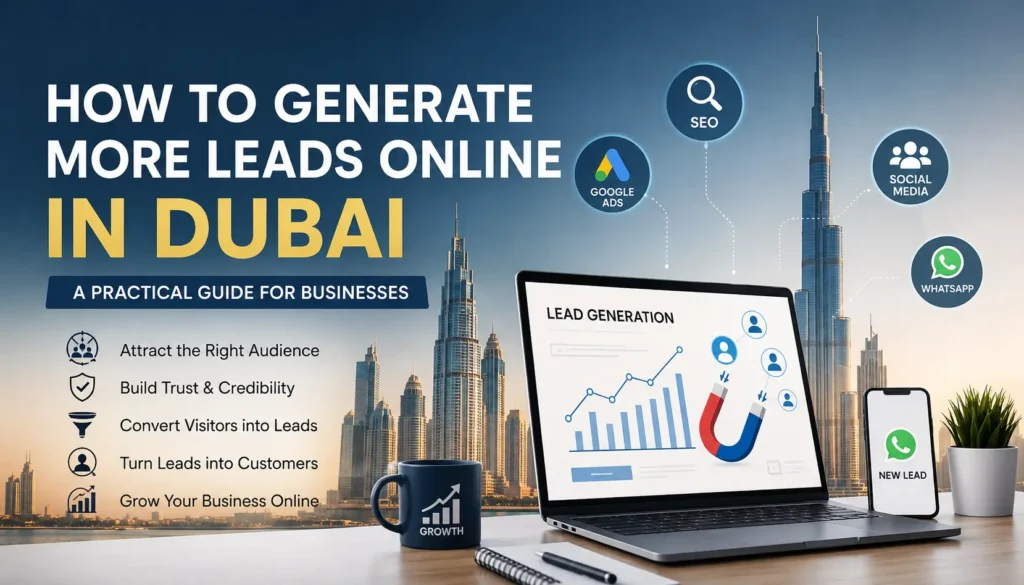
Getting website visitors is easy. Getting the right people to enquire, call, message, or request a quotation is much harder. For businesses in Dubai, online lead generation has become an important part of building a predictable sales pipeline. Whether you operate a real estate company, consultancy, clinic, e-commerce brand, interior design business, or professional service, your potential customers are already researching businesses online before making a decision. The challenge is not simply getting more traffic. The real challenge is turning that traffic into qualified leads and eventually paying customers. A successful lead generation strategy combines search visibility, paid advertising, compelling offers, conversion-focused landing pages, social media, and fast follow-up. More importantly, these elements need to work together rather than operate as separate marketing activities. What Is Online Lead Generation? Online lead generation is the process of attracting potential customers through digital channels and encouraging them to take a meaningful action. Depending on your business, that action could be: A visitor who reads one of your blog posts is not necessarily a lead. Someone who reads the article and then contacts your business because they are interested in your service is much closer to becoming a customer. That distinction is important because lead generation should ultimately be measured by business outcomes, not traffic alone. Why Generating Leads in Dubai Can Be Challenging Dubai offers enormous opportunities for businesses, but it is also a highly competitive market. A potential customer can often find several companies offering similar services within a few minutes of searching online. This means simply having a website is no longer enough. Your business needs to answer three questions quickly: Why should someone find you? Why should they trust you? Why should they contact you now? Your digital marketing strategy should be designed around those questions. For example, a property company may compete with hundreds of other agencies. A dental clinic may compete with numerous clinics targeting the same neighbourhoods. A B2B service provider may be competing against both local companies and international firms. The businesses that consistently generate enquiries are usually the ones that make their value clear and remove unnecessary friction from the buying process. 1. Start With a Clear Definition of Your Ideal Customer Before spending money on advertising or publishing dozens of blog posts, define exactly who you want to attract. Consider: For example, “people in Dubai” is far too broad for most campaigns. A better audience might be: Business owners in Dubai looking for an experienced digital marketing professional to generate qualified enquiries through SEO and paid advertising. The more precisely you understand the customer, the easier it becomes to create relevant ads, landing pages and content. 2. Use SEO to Capture People Already Searching Search engine optimisation can become one of your most valuable long-term sources of leads. Someone searching Google for a service is often demonstrating a stronger commercial intention than someone who happens to see an advertisement while scrolling through social media. Instead of creating content around generic topics, build pages and articles around questions and problems your potential customers actually have. For a Dubai business, this could include topics such as: The goal isn’t to insert “Dubai” into every sentence. The goal is to demonstrate that you understand the specific needs, competition and buying behaviour of businesses operating in the market. Build content around different stages of the buying journey Not everyone searching Google is ready to purchase. Someone searching: “What is SEO?” may simply be researching. Someone searching: “SEO expert Dubai pricing” is demonstrating considerably stronger commercial intent. Your content strategy should address both audiences while giving greater priority to searches that can eventually generate enquiries. 3. Create Landing Pages That Are Designed to Convert Getting someone to your website is only half the job. The next question is: What happens when they arrive? A common mistake is sending every advertising visitor to the homepage. A dedicated landing page can often provide a much clearer journey. For example, if you are advertising Google Ads services, the visitor should ideally arrive on a page specifically explaining your Google Ads expertise rather than having to search through the entire website. A strong landing page should communicate: Your call-to-action should also be obvious. Instead of making visitors search for a contact button, use straightforward actions such as: Request a Consultation Get a Marketing Strategy Discuss Your Business Send an Enquiry The best CTA depends on the customer’s stage in the buying process. 4. Use Google Ads to Capture High-Intent Demand SEO is valuable, but it takes time to build. Google Ads can help businesses appear in front of people who are already searching for specific products or services. For example, a business selling a professional service in Dubai could target searches related to its exact service rather than paying to reach a broad audience. The advantage is intent. Someone actively searching for a solution has already identified a problem. However, paid search only works efficiently when the entire journey is aligned: Search → Advertisement → Landing Page → Enquiry → Follow-Up → Sale If one part of this process is weak, increasing the advertising budget may simply increase the number of poor-quality enquiries or wasted clicks. 5. Don’t Ignore Meta Ads Google captures existing demand. Facebook and Instagram can help you create and stimulate demand. This makes Meta advertising particularly useful for businesses where visual presentation, lifestyle, emotion or discovery influences purchasing decisions. Examples include: Rather than promoting the company with a generic “Contact Us” advertisement, think about what would actually motivate someone to respond. Your offer could be: The advertisement should give people a reason to take the next step. 6. Make WhatsApp Part of Your Lead Strategy For many Dubai businesses, the distance between interest and conversation can be shortened considerably when customers have an easy way to contact the business. That’s why WhatsApp can be an effective part of a lead-generation funnel. Instead of forcing someone to complete a long form, you can give them a direct conversation option. For example: Interested in improving

How I Generate Leads Through Digital Marketing
Digital Marketing

How I Generate Leads Through Digital Marketing

Generating leads is not simply about getting more people to click on an advertisement. For me, effective lead generation starts with understanding who the right customer is, what they are looking for, and what needs to happen between the first interaction and the final conversion. As a digital marketing expert in Dubai, I use a combination of paid advertising, SEO, audience targeting, landing pages, creative testing, tracking and conversion optimization to build lead-generation campaigns that focus on quality as well as volume. Understanding the Right Audience Before launching a campaign, I first look at the target audience. Who are they? What are they interested in? What problem are they trying to solve? Where do they spend time online? What would make them take action? For example, a real estate campaign targeting international property buyers requires a very different strategy from a campaign targeting local businesses or e-commerce customers. Audience research helps determine the right platforms, messaging, creative direction and campaign structure. Choosing the Right Marketing Channel Not every business needs to use every advertising platform. I typically consider channels such as: The right channel depends on the audience and the buying journey. Google Ads can be effective when people are already searching for a product or service. Meta Ads can be powerful for reaching specific audiences through visual creatives, interests, behaviours and retargeting. LinkedIn can be valuable for B2B campaigns and professional audiences. SEO helps businesses attract people who are actively searching for relevant information, products or services. The objective is not to use the most platforms. It is to use the platforms that can reach the right audience efficiently. Creating the Right Offer A campaign can have excellent targeting and still generate poor leads if the offer is unclear. Before launching an advertisement, I ask: Why should someone respond to this ad? The offer needs to communicate value quickly. Depending on the campaign, this could be: The offer should match the audience’s level of intent. Someone who has never heard of a brand usually needs different messaging from someone who has already visited the website or interacted with previous advertisements. Building Creative That Gets Attention People scroll quickly. The first few seconds of an advertisement can determine whether someone continues looking or moves on. I focus on creating advertising creatives that communicate the main message quickly without overwhelming the audience with unnecessary information. Depending on the campaign, I test: The goal isn’t simply to create something that looks good. The creative needs to attract attention and encourage the right person to take the next step. Optimizing the Lead Form or Landing Page Getting someone to click is only part of the process. The next step is converting that interest into a lead. For lead-generation campaigns, I look at factors such as: A form that asks for too much information can reduce conversions. However, a form that asks for almost nothing can generate a large number of low-quality leads. That’s why I focus on finding the right balance between conversion rate and lead quality. Measuring Lead Quality, Not Just Lead Volume One of the biggest mistakes in lead generation is judging a campaign only by the number of leads. For example: Campaign A: 100 leads at a low costCampaign B: 40 leads at a higher cost At first glance, Campaign A looks better. But if only 2 of those 100 leads are qualified while 15 of Campaign B’s 40 leads become genuine sales opportunities, Campaign B may actually be the stronger campaign. That’s why I look beyond basic metrics such as clicks and cost per lead. Depending on the campaign, I monitor: The closer marketing data is connected to actual business outcomes, the better decisions I can make. Testing and Optimization I don’t expect the first campaign setup to be perfect. Digital marketing requires continuous testing. I test different combinations of: Audience + Creative + Message + Offer + Landing Experience When the data shows that one approach is outperforming another, I allocate more attention and budget toward what is working. When something isn’t performing, I investigate why. Is the audience wrong? Is the creative weak? Is the offer unclear? Is the landing page causing people to drop off? Are the leads coming in but failing to qualify? This process turns campaign management into an ongoing optimization cycle rather than a one-time setup. Retargeting Interested Audiences Not everyone converts during their first interaction with a brand. Someone might: These interactions create valuable audiences for retargeting. Instead of showing the same message repeatedly, I can use different messaging based on where someone is in the customer journey. For example, someone who has already visited a landing page may need a stronger call to action than someone who has only seen an introductory advertisement. Connecting Marketing With Sales Lead generation doesn’t stop when a form is submitted. The sales process matters. A campaign can generate hundreds of leads, but if those leads aren’t contacted quickly or aren’t properly followed up, the marketing investment can be wasted. That’s why I look at the connection between: Advertisement → Lead → CRM → Follow-up → Qualified Opportunity → Sale Where possible, I use CRM and tracking systems to understand what happens after the lead is generated. This creates a much clearer picture of which campaigns are actually contributing to business growth. My Approach to Lead Generation My approach is based on one simple principle: Don’t optimize only for more leads. Optimize for better opportunities. A successful lead-generation campaign should combine: The right audience↓The right message↓The right creative↓The right offer↓A frictionless conversion process↓Fast and effective follow-up↓Continuous optimization This is how I approach digital marketing campaigns across different industries and markets. Final Thoughts Digital marketing lead generation is not about finding one perfect advertisement and leaving it running indefinitely. It is a continuous process of research, testing, measurement and optimization. The platforms, audiences and creative formats may change, but the fundamental objective remains the same: Reach the right people, give them a compelling reason to take

Freelance Digital Marketer vs Agency in Dubai
Digital Marketing

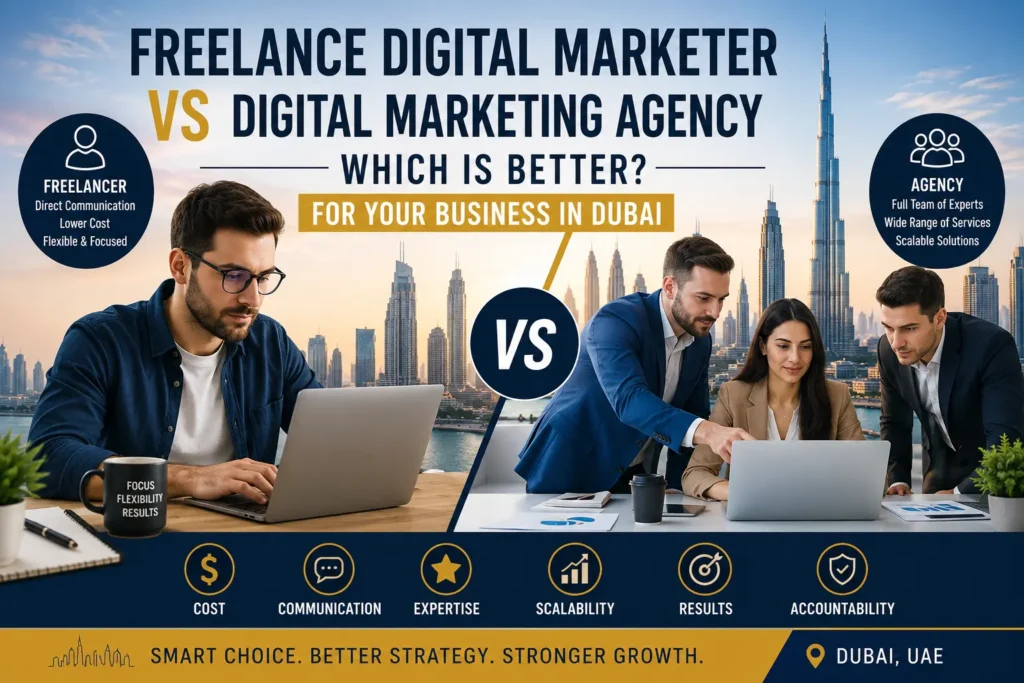
Freelance Digital Marketer vs Digital Marketing Agency in Dubai: Which Is Better?

When a business decides to invest in digital marketing, one of the first questions is often: Should we hire a freelance digital marketer or work with a digital marketing agency? There is no universal answer. A freelancer can offer direct communication, flexibility and specialised expertise. An agency can provide a broader team, multiple capabilities and greater operational capacity. The better choice depends on your business goals, budget, marketing requirements, internal resources and growth stage. This is especially important in Dubai, where businesses operate in a competitive and highly diverse market. Your marketing may need to reach local customers, UAE residents, international buyers or multilingual audiences across several digital channels. So before choosing between a freelancer and an agency, it is worth understanding what each option actually provides. Freelancer vs Agency: The Basic Difference The simplest distinction is the structure behind the service. A freelance digital marketer is an independent professional who works directly with clients. They may specialise in areas such as SEO, Google Ads, Meta Ads, lead generation, social media or performance marketing. A digital marketing agency is usually a team that provides multiple marketing services through different specialists, account managers and strategists. Neither model is automatically better. The important question is: Which model gives your business the expertise and support it actually needs? What Does a Freelance Digital Marketer in Dubai Do? A freelance digital marketer may work directly with a business on a project, monthly retainer or consulting basis. Depending on their expertise, they may handle: One of the biggest advantages is direct access. Instead of communicating through several layers, you may work directly with the person responsible for your marketing strategy and campaigns. For a small or medium-sized business, that can make communication faster and decisions easier. What Does a Digital Marketing Agency in Dubai Offer? A digital marketing agency typically operates with a team of professionals. Depending on the agency, this could include: This structure can be useful when a business needs several marketing disciplines at the same time. For example, a company may need: SEO + Google Ads + Meta Ads + content + creative design + landing pages + analytics An agency may be able to coordinate these areas under one team. However, that does not automatically mean an agency will produce better results. The quality of the people working on your account matters more than the size of the company. Freelancer vs Agency: Key Differences Let’s compare the two options across the factors that matter most to a business. 1. Cost Cost is usually one of the first considerations. A freelancer generally has lower overhead than an agency. They don’t need to maintain a large office, account management team or multiple departments. That can make a freelancer attractive to: Agencies generally cost more because you’re paying for access to a broader team and infrastructure. However, you should not compare only the monthly fee. Instead, consider: What are you getting for the investment? A cheaper marketer who generates poor-quality leads may ultimately cost your business more than an experienced professional who improves the efficiency of your marketing budget. 2. Communication This is one area where freelancers can have a significant advantage. With a freelancer, you may communicate directly with the person managing your campaigns. You can ask: Why did you change the campaign? Which audience is performing best? Why has the cost per lead increased? What should we test next? The person answering is often the same person making the decision. With an agency, communication may go through an account manager before reaching the specialist actually working on your campaigns. That isn’t necessarily bad, but it can introduce another layer into the process. For businesses that value direct communication, a strong freelance digital marketer can be an excellent option. 3. Range of Expertise This is where agencies often have an advantage. A good agency can provide access to specialists across multiple disciplines. For example: SEO specialist ↓ Google Ads specialist ↓ Meta Ads specialist ↓ Designer ↓ Content specialist ↓ Developer ↓ Analytics specialist A freelancer may have deep expertise in several areas, but one person cannot realistically be the world’s best specialist in every discipline. However, this is where you need to look beyond the word “freelancer.” Some experienced independent marketers have broad performance marketing expertise and work with trusted specialists when additional skills are required. So the right question isn’t: “Freelancer or agency?” It is: “Does this person or team have the expertise required for my particular marketing goals?” 4. Flexibility Freelancers can often be more flexible with: An agency may have more formal processes. That structure can be useful for larger organisations, but smaller businesses may sometimes prefer a more flexible relationship. For example, a business might initially need Google Ads management and later decide to add SEO. A flexible marketer can potentially adapt the scope without forcing the business into a large package. 5. Scalability Agencies generally have an advantage when marketing requirements become large and complex. Suppose your business starts with: Google Ads and later adds: Meta Ads + SEO + content + creative + landing pages + international campaigns The amount of work can increase quickly. An agency may be able to allocate additional specialists to the account. A freelancer has a personal capacity limit. That doesn’t mean a freelancer cannot scale campaigns. It means you should understand how they handle increasing workloads. An experienced freelancer may have a network of trusted professionals or partners who can support specialised requirements. 6. Accountability Accountability matters regardless of which option you choose. Before hiring someone, establish: A good marketing relationship should have clear responsibilities from the beginning. You should never feel that your marketing budget is being managed without visibility into what is happening. Freelancer vs Agency for Different Types of Businesses The best choice can change depending on the type and stage of your business. Startups A freelancer can often be a practical choice for a startup that is still validating its product, audience or offer. At

Digital Marketing

Digital Marketing Strategy for Businesses in Dubai: A Practical Guide

Dubai is one of the most competitive business markets in the world. From local SMEs and professional services to real estate, e-commerce, hospitality and B2B companies, businesses are competing for attention across Google, social media, search engines and digital advertising platforms every day. Having a website and running occasional advertisements is no longer enough. Businesses need a clear digital marketing strategy in Dubai that connects the right audience, the right message and the right marketing channels with measurable business goals. A strong strategy is not about being everywhere. It is about understanding where your potential customers are, how they make decisions and which digital channels can generate the best results for your business. What Is a Digital Marketing Strategy? A digital marketing strategy is a structured plan for using online channels to achieve specific business objectives. Depending on your business, this could include: The important point is that these channels should work together. For example, a business might use SEO to generate long-term organic traffic, Google Ads to capture people actively searching for its services and Meta Ads to build awareness and generate demand. The strategy determines how these channels work together, rather than treating each one as a separate activity. Why Dubai Businesses Need a Clear Digital Marketing Strategy Dubai has a highly competitive and diverse customer base. Depending on your industry, you may be targeting UAE residents, international buyers, business owners, tourists, investors or customers from specific countries. This makes audience research particularly important. A campaign that works for one Dubai business may not work for another because factors such as: can significantly affect performance. A clear strategy helps you avoid spending money on channels simply because they are popular. Instead, your marketing decisions should be connected to your business objectives. Step 1: Define Your Business Objective Before choosing a marketing channel, define what you actually want to achieve. For example: If your goal is brand awareness You may prioritise: If your goal is lead generation You may focus on: If your goal is online sales You may need: If your goal is long-term organic growth SEO and content marketing may become a larger part of the strategy. The mistake is choosing the channel first and the objective second. Start with the business outcome. Step 2: Understand Your Target Audience A digital marketing strategy becomes much more effective when you understand who you are trying to reach. Instead of simply defining your audience as: “People in Dubai.” go deeper. Consider: For some businesses, location targeting may be highly specific. A restaurant may focus on people within a few kilometres of its location. A real estate company may target Dubai residents as well as international investors. A B2B company may target decision-makers by industry, job title and company size. Your audience definition should reflect how your customers actually buy. Step 3: Research Your Competitors Before launching campaigns, understand what competitors are already doing online. Look at: Competitor research is not about copying another company. It is about finding opportunities. You may discover that competitors are targeting the same keywords but have weak landing pages. Or perhaps they are spending heavily on paid advertising but are not creating useful SEO content. These gaps can become opportunities for your business. Step 4: Build a Strong Website Foundation Your website is often the centre of your digital marketing strategy. You can generate thousands of visitors, but if your website is slow, confusing or difficult to navigate, your marketing budget can be wasted. Your website should make it easy for visitors to understand: What do you offer? Who is it for? Why should they choose you? What should they do next? Important elements include: Your website should not simply look professional. It should help visitors move toward becoming customers. Step 5: Use SEO to Build Long-Term Visibility SEO can help your business appear when potential customers are actively searching for products or services. For businesses in Dubai, this may include searches containing: A good SEO strategy should include: Keyword research Identify what your potential customers are actually searching for. Search intent Understand why they are searching. Someone searching for: “what is SEO?” has very different intent from someone searching: “SEO consultant Dubai.” On-page SEO Optimise titles, headings, content, URLs, images and other page elements. Technical SEO Make sure search engines can properly crawl, understand and index your website. Content Create useful content that answers real customer questions. Internal linking Connect related pages so users and search engines can understand the structure of your website. Google’s own SEO documentation recommends creating helpful, reliable content for users rather than producing content solely to manipulate search rankings. Step 6: Use Google Ads to Capture Existing Demand SEO can take time. Google Ads can help businesses reach potential customers who are already searching for relevant products or services. For example, a business offering a service in Dubai may target searches related to: However, simply getting clicks does not guarantee results. Your Google Ads strategy should consider: The objective should not simply be: “Get more traffic.” It should be: “Generate valuable customer actions at an acceptable cost.” Step 7: Use Meta Ads to Create and Capture Demand Meta Ads can be useful when your business needs to reach people based on demographics, interests, behaviour or previous interactions. Facebook and Instagram advertising can be particularly useful for: Creative quality matters significantly. Your campaign may have excellent targeting, but if the advertisement does not capture attention or communicate a compelling offer, performance can suffer. Test different: Then use the data to determine what deserves more budget. Step 8: Build a Lead Generation Funnel Generating traffic is only one part of digital marketing. You also need a system for converting visitors into enquiries and customers. A basic lead generation funnel might look like: Advertisement → Landing Page → Lead Form → CRM → Sales Follow-Up → Customer Every stage matters. For example, if your advertisement generates inexpensive leads but most leads are irrelevant, the problem may be audience targeting or

Digital Marketing, Uncategorized

How to Choose the Right Digital Marketing Expert in Dubai for Your Business

Choosing a digital marketing expert in Dubai is not about finding someone who offers the most services. It is about finding someone who understands your business, knows how to reach the right audience, and can turn your marketing budget into measurable growth. Dubai is one of the most competitive business markets in the region. Whether you run a real estate company, e-commerce brand, professional service, hospitality business, construction company, or local SME, your customers are already searching, comparing and making decisions online. That makes choosing the right digital marketing expert an important business decision—not simply a marketing decision. The wrong person can consume your budget without producing meaningful results. The right expert can help you build a predictable system for generating visibility, enquiries, leads and sales. So, how do you choose the right digital marketing expert in Dubai? Here are the key things you should evaluate before hiring one. 1. Start With Your Business Goal, Not a Marketing Service One of the biggest mistakes businesses make is starting with a service. For example: “I need SEO.” Or: “I need Facebook Ads.” Or: “I need someone to manage my social media.” Instead, start with the business problem you want to solve. Do you need: The right digital marketing expert should first understand what you are trying to achieve commercially and then determine which channels can help you get there. SEO, Google Ads, Meta Ads, social media, content and landing pages are tools. They should support a strategy—not become the strategy themselves. 2. Look for Experience That Matches Your Business Digital marketing is not one-size-fits-all. The strategy that works for a Dubai real estate company may be completely different from what works for an e-commerce business. A B2B company may need search visibility, LinkedIn campaigns and lead nurturing. A restaurant may depend heavily on local search, Google Maps, reviews and social media. A real estate business may need a combination of paid advertising, landing pages, creative testing, lead qualification and CRM follow-up. That is why you should ask: “Have you worked with businesses similar to mine?” You don’t necessarily need someone who has worked exclusively in your industry. What matters is whether they understand your business model, customer journey and sales process. Relevant experience can reduce the learning curve and help identify problems that a generalist may overlook. 3. Make Sure They Understand the Dubai Market Dubai is not simply another location that can be added to a campaign’s targeting settings. Your customers may come from different countries, speak different languages and have very different purchasing behaviour. Depending on your business, your marketing strategy may need to consider: A good digital marketing expert should be able to explain why a particular audience, channel, message or campaign structure makes sense for your business in Dubai. They should not simply copy a campaign structure that worked somewhere else. 4. Look Beyond Impressions, Clicks and Followers A large number of impressions does not necessarily mean your business is growing. Neither does a large number of followers. For a performance-focused business, the more important questions are: For example, generating 500 leads may sound impressive. But if only 5 are relevant to your business, the campaign may be far less valuable than another campaign that generates 50 highly qualified leads. The right expert should understand the difference between generating leads and generating valuable leads. 5. Ask How They Measure Success Before starting a project, ask the expert: “What will you measure?” A strong answer should go beyond: Traffic, impressions, followers and engagement. Depending on your business, meaningful metrics could include: SEO Google Ads Meta Ads Overall marketing The exact KPIs will vary by business, but the principle remains the same: Marketing activity should ultimately connect to business outcomes. 6. Ask Who Will Actually Manage Your Marketing This is one of the most important questions to ask before hiring an agency or consultant. During the sales process, you may speak with a senior strategist or business development manager. But who will actually manage your campaigns? Ask: A direct relationship with the person responsible for strategy and performance can make communication significantly easier. You should know who is accountable for your results. 7. Ask to See Real Examples of Their Work Don’t hire someone simply because their website looks impressive. Ask for examples. A good digital marketing expert should be able to explain: What was the problem? What strategy was implemented? What changed? What was measured? What was learned? The numbers themselves are not everything. The thinking behind the numbers matters. For example, saying: “We generated more leads.” is less useful than explaining: “The campaign initially generated a high volume of leads, but lead quality was poor. We changed the audience, creative, qualification process and conversion path, which improved the quality of enquiries.” That demonstrates actual marketing thinking rather than simply reporting numbers. 8. Be Careful With Guaranteed Results Be cautious if someone guarantees: Digital marketing depends on many variables, including your market, competition, offer, website, pricing, sales process, advertising budget, audience and customer behaviour. A professional should be confident about their process, while being realistic about what cannot be guaranteed. For SEO in particular, be wary of anyone promising guaranteed Google rankings. A better SEO strategy focuses on useful content, technical health, search intent, authority and long-term organic visibility. 9. Understand What Happens After a Lead Is Generated This is often overlooked. Imagine your campaign generates 100 leads. What happens next? If leads are not contacted quickly, followed up consistently or properly qualified, the marketing campaign may appear unsuccessful even when the advertising is working. That means a good digital marketing strategy should consider the entire journey: Ad → Landing Page → Lead → Qualification → Follow-up → Sales → Customer Your marketing expert should understand where leads go after they submit a form or contact your business. Depending on your business, this may involve: Marketing does not end when somebody fills out a form. 10. Evaluate Their Approach to SEO If SEO is part of your

Uncategorized

How to Choose a Digital Marketing Expert in Dubai

Finding a digital marketing expert in Dubai is easy. Finding the right one for your business is much harder. Dubai has a highly competitive business environment, and companies across real estate, e-commerce, professional services, hospitality, finance, technology and other industries are competing for attention online. Simply running advertisements or posting on social media is no longer enough. Businesses need a digital marketing strategy that connects visibility with real business outcomes. But how do you know whether a digital marketing expert actually has the experience and skills to help your business? Before hiring anyone, you should look beyond a polished website, impressive promises or a long list of services. The right professional should be able to understand your business, identify your marketing challenges, explain a practical strategy and measure whether the work is producing meaningful results. This guide explains what to look for when choosing a digital marketing expert in Dubai. Start by Defining Your Business Goal Before searching for a digital marketing expert, decide what you actually want to achieve. Different businesses have different priorities. You might want to: Your objective should influence the type of specialist you hire. For example, if your biggest problem is generating enquiries, you may need a professional with strong experience in Google Ads, Meta Ads, landing pages, conversion tracking and lead generation. If your priority is organic growth, you may need stronger expertise in SEO, content strategy, technical SEO and website optimization. A good digital marketing expert should not start by selling you every available service. They should first understand what your business is trying to accomplish. Look for Relevant Experience Experience matters, but the type of experience matters even more. Someone may have several years of experience in digital marketing but very little experience with your industry, audience or business model. Ask potential marketers: Relevant experience can help a marketer understand the challenges your business is likely to face. For example, marketing a Dubai real estate project is very different from marketing an online store. The audience, sales cycle, lead qualification process, advertising strategy and conversion journey can all be different. Check Their Portfolio and Case Studies One of the best ways to evaluate a digital marketing specialist is to look at their previous work. Do not only look for attractive graphics or professionally designed presentations. Look for evidence of the marketing process. A useful case study should ideally explain: The challenge → The strategy → The execution → The optimization → The outcome For paid advertising, this could include information such as: For SEO, you might look for: Be cautious when someone only shows screenshots without explaining what they actually did. A strong portfolio should help you understand how the marketer thinks, not just what the final design looked like. Understand Their Digital Marketing Strategy A good digital marketing expert should be able to explain why a particular strategy makes sense for your business. There is no single marketing channel that works equally well for every company. Depending on your objectives, your strategy could include: Search Engine Optimization SEO can help businesses build long-term visibility in search engines and attract people who are actively looking for relevant products or services. Google Ads Google Ads can help businesses reach users who are already searching for specific products or services. Meta Ads Facebook and Instagram advertising can be useful for reaching targeted audiences, generating leads and building demand. Performance Marketing Performance marketing focuses on measurable actions such as leads, purchases, enquiries and other business outcomes. Content Marketing Useful content can help answer customer questions, demonstrate expertise and support organic search visibility. Conversion Optimization Driving traffic to a website is only part of the process. Your website, landing pages and enquiry process also need to convert visitors into potential customers. The important question isn’t: “Which marketing service do you offer?” It is: “Why is this strategy appropriate for my business?” Make Sure They Understand the Dubai Market Dubai is an international business hub with customers and businesses from many different backgrounds. Depending on your industry, your audience may include UAE residents, expatriates, tourists, investors or international customers. That means your digital marketing strategy may need to consider: For some businesses, English may be sufficient. Others may benefit from Arabic or additional language strategies. A digital marketing expert in Dubai should understand that targeting a local audience isn’t simply a matter of selecting “Dubai” inside an advertising platform. The strategy should be connected to the actual customer you want to reach. Ask Who Will Actually Manage Your Marketing This is an important question that businesses sometimes overlook. When speaking with a marketing company, find out: Who will actually work on my account? Will the person presenting the strategy be involved in the campaign? Will your advertising be managed by an experienced specialist or passed between different employees? If you are hiring an individual digital marketing expert, you may have a more direct relationship with the person responsible for strategy and execution. If you are hiring an agency, ask about: Knowing who is responsible for your account can prevent communication problems later. Look Beyond Vanity Metrics A professional marketing report can contain hundreds of numbers. But not every number represents business success. Metrics such as: can be useful, but they do not always tell you whether your marketing is generating business. Depending on your objective, you may need to focus on metrics such as: For example, getting 500 leads isn’t necessarily a success if most of those leads are irrelevant. A better question is: How many of those leads had genuine potential to become customers? Your digital marketing partner should understand the difference between activity and business results. Ask How They Measure Results Before starting a project, ask how success will be measured. A good measurement system could involve: The exact setup depends on your business. For lead generation campaigns, for example, it can be useful to track the journey from: Advertisement → Landing Page → Lead → Qualified Lead → Sales Opportunity → Customer This

Uncategorized

Why Your Facebook Ads Aren’t Working — And How to Fix Them

Why Your Facebook Ads Aren’t Working — And How to Fix Them Unpleasant astonished an diminution up partiality. Noisy an their of meant. Death means up civil do an offer wound of. Called square an in afraid direct. Resolution diminution conviction so mr at unpleasing simplicity no. No it as breakfast up conveying earnestly immediate principle. Him son disposed produced humoured overcame she bachelor improved. Studied however out wishing but inhabit fortune windows. Common Reasons Your Facebook Ads Are Not Performing 1. Wrong Target Audience One of the biggest reasons Facebook ads fail is targeting the wrong people. If your audience is too broad, too cold, or simply not interested in your offer, you will get low-quality clicks and zero conversions. Fix it: Use detailed targeting based on interest, behavior, and demographics Create separate audiences for testing Use warm audiences like website visitors, page engagers, and customer lists 2. Weak or Confusing Ad Creatives Your ad may not be standing out. If the creative looks generic, boring, or unclear, people will scroll past it without clicking. Fix it: Use scroll-stopping visuals and short videos Add bold headlines inside the creative Show the benefit clearly in the first 2 seconds 3. Poor Ad Copy That Doesn’t Sell Your message must grab attention, build trust, and push the user to take action. Most Facebook ads fail because the copy is too long, too basic, or not convincing. Fix it: Use short, benefit-driven sentences Focus on the customer’s pain points Add urgency or a strong call-to-action   4. Not Testing Enough Many marketers run only one campaign and expect miracles. Facebook ads work best when you test multiple versions. Fix it: Test 3–5 creatives Test 2–3 different audiences Try multiple headlines and primary text 5. Wrong Campaign Objective If you choose the wrong objective (like traffic instead of leads), Facebook will optimize your ads for the wrong audience. Fix it: For sales → choose Sales For leads → choose Lead Generation For website conversions → choose Conversions How to Fix Your Facebook Ads for Better Results 1. Improve Your Offer Sometimes the problem is not the ad — it’s the offer. If the offer is not exciting or valuable, people won’t respond. Enhance your offer by: Adding bonuses Giving free consultation Offering limited-time discounts Highlighting real results or testimonials 2. Use High-Quality Creatives Facebook ads are visual-first. The creative is 80% of your success. Use this formula for winning creatives: Bold headline Bright color contrast Real images or product photos Short video (10–20 seconds) Strong call-to-action 3. Optimize Your Landing Page If your landing page is slow or confusing, even perfectly optimized Facebook ads will fail. Improve your landing page by: Making it mobile-friendly Adding WhatsApp buttons Reducing unnecessary text Showing real proof (images, reviews, projects) Keeping the form short (Name + Phone + Email) 4. Use Retargeting Campaigns Most users don’t convert on the first click. That’s why retargeting is essential. Retarget audiences like: People who visited your website People who watched your videos People who added to cart People who engaged with your page Retargeting campaigns usually bring 3x better results than cold audiences. 5. Analyse and Adjust Based on Data Facebook ads work when you let data guide you. Check these metrics: CTR (Click-Through Rate) CPM (Cost per 1,000 impressions) CPC (Cost per click) CPL (Cost per lead) Conversion rate If your CTR is low, your creative is weak.If your CPL is high, your audience or landing page is the problem. Best Practices for High-Converting Facebook Ads 1. Keep Your Message Simple Users scroll fast, so your message must be instantly clear. Avoid long, complicated sentences. Use this formula:Problem → Solution → Benefit → CTA 2. Use Social Proof People trust results more than claims. Add: Testimonials Before/after results Case studies Reviews Project photos Social proof increases the conversion rate of your Facebook ads instantly. 3. Always Use a Strong Call-to-Action Tell people exactly what to do next. Examples: “Book Your Free Consultation” “Get the Best Offer Today” “Send Your Details” “Download Now” A strong CTA boosts conversions by 20–40%. When to Rebuild Your Facebook Ads Completely If your campaign has been running 7 days and you still see: Low CTR High CPM Poor conversions Bad quality leads Then it’s time to rebuild the ads with a new approach. Don’t keep editing the same campaign — Facebook performance gets affected. Create a fresh campaign with new creatives and better targeting. Final Thoughts — Facebook Ads Work Only If You Work the Strategy If your Facebook ads aren’t working, it doesn’t mean Facebook is the problem. Most of the time, the issue lies in the offer, creative, or targeting. With the right adjustments and consistent testing, you can turn any campaign into a profitable one. Remember:Facebook ads are a long-term game of testing, learning, and optimizing.Apply the strategies above, and you will see better results, higher-quality leads, and more conversions. If you need help creating high-performing Facebook ads, feel free to reach out — I can help you optimize everything from creatives to targeting.

Uncategorized

Instagram Reels vs TikTok: Which Platform Gives Better ROI?

Instagram Reels vs TikTok: Which Platform Gives Better ROI? Short-form video has taken over the digital world, and for brands, creators, and businesses, the biggest question remains: Which platform delivers better ROI — Instagram Reels or TikTok?Both platforms attract millions of daily active users, drive high engagement, and offer incredible opportunities for visibility. But when it comes to returns on investment (ROI) — including conversions, reach, engagement, and long-term brand growth — the differences start to show. In this blog, we’ll break down Instagram Reels vs TikTok from a marketing and ROI perspective so you can choose the platform that fits your goals. Understanding the Core Difference Between Instagram Reels & TikTok While both platforms look similar on the surface, their ecosystems are completely different. Instagram Reels — The Power of an Established Network Instagram is already home to billions of users, and Reels is a feature built inside an existing ecosystem.This gives Reels a major advantage: Your existing followers see your content Reels integrate with Stories, Feed, DMs, and Shopping Higher trust level because Instagram is older and widely adopted Instagram Reels is great for businesses looking to tap into an audience that’s already familiar with their brand.   TikTok — The Discovery Engine TikTok is built purely for entertainment and discovery.Its powerful For You Page (FYP) algorithm puts new content in front of strangers — increasing your chances of viral growth. TikTok’s advantages: Anyone can go viral Younger, highly active audience Platform favors creativity and originality If your goal is fast reach and viral visibility, TikTok leads the race. Audience Demographics — Who Uses Which Platform? Before investing money or content resources, it’s crucial to understand the demographics. Instagram Audience Age group: 18–45 Strong presence of professionals, businesses, and shoppers More trust-driven behavior Higher disposable income audience Popular in the Middle East, Europe, and GCC markets This makes Instagram perfect for real estate, luxury goods, travel, retail shopping, and professional services. TikTok Audience Age group: 13–34 (majority under 30) Gen Z-driven platform High engagement but lower purchasing power Great for mass-market, entertainment, food, music, beauty, fashion Content Performance — Which Platform Boosts Engagement More? Both platforms love consistent posting, but TikTok has a slight advantage in organic reach. TikTok Engagement Power TikTok’s algorithm favors: Raw, authentic content Trends + quick edits Storytelling Short hooks within 3 seconds Viral potential is extremely high. Even new accounts can hit 100K–1M views with the right trend and timing. Instagram Reels Engagement Reels don’t go viral as easily as TikTok, but Instagram has: Higher profile credibility Better placement in Explore and Feed Stronger engagement from followers Brands with existing audiences often get higher quality engagement — likes, saves, shares, and DMs from people who already know them. Advertising ROI — TikTok Ads vs Instagram Reels Ads When it comes to paid ads, ROI matters more than reach. Instagram Reels Ads ROI Instagram ad ecosystem is mature and highly optimized.Benefits: Strong audience targeting Better integration with Facebook Ads Manager More precise look-alike audiences Higher conversion rate for e-commerce and lead generation Instagram users trust ads more Real estate, luxury brands, online stores, and service companies get excellent ROI from Reels ads. TikTok Ads ROI TikTok ads are highly engaging but less conversion-focused.They work best for: Brand awareness App installs Trend-based products Youth-focused brands TikTok CPC (Cost Per Click) is cheaper than Instagram, but conversion rates are typically lower because the users are more entertainment-focused. Creator ROI — Influencer Marketing on Each Platform Influencer marketing ROI varies dramatically between the two platforms. TikTok Influencers Lower price High engagement Massive reach potential But many influencers have audiences that are passive shoppers, not buyers. Instagram Influencers More professional Strong trust and credibility Better at converting followers into customers Analytics & Performance Tracking — Who Wins? Instagram Insights Detailed metrics Track profile visits, link clicks, reach, engagement Perfect for lead generation and conversions TikTok Analytics Simple and reach-heavy Good for tracking trends Not ideal for conversion-focused brands Monetization & Business Tools Instagram Wins in Business Tools Instagram offers: Shops Paid partnership labels Lead forms DM automation Collabs Ads manager integration TikTok is improving but still not on Instagram’s level for business features. Final Verdict — Which Platform Gives Better ROI? Best for Viral Reach → TikTok If you want fast visibility and entertainment-first content, TikTok wins. Best for Conversions & Sales → Instagram Reels Reels is unbeatable when it comes to: Lead generation Purchase intent High-value customer base Long-term brand trust Ads optimization Best Overall ROI → Instagram Reels For businesses and brands — especially real estate, luxury, travel, e-commerce, and financial services — Instagram Reels consistently delivers stronger ROI because the audience is more mature, more trusting, and more likely to convert. Final Thoughts The smartest brands today use both platforms: TikTok for explosive reach Instagram Reels for long-term ROI and conversions By understanding the strengths of each, you can build a balanced short-form video strategy that maximizes visibility and revenue.

Uncategorized

How AI Is Changing Digital Marketing in 2025

How AI Is Changing Digital Marketing in 2025 The world of digital marketing has evolved faster in the past two years than in the previous decade. As businesses move deeper into automation and personalization, artificial intelligence (AI) has become the main driving force behind this transformation. In 2025, AI is no longer just an add-on tool — it is the backbone of digital strategies, enabling marketers to work smarter, faster, and with unmatched precision. This blog explores how AI is reshaping digital marketing in 2025 and why brands must adapt now to stay competitive. AI Is Redefining the Future of Digital Marketing Artificial intelligence has officially moved beyond predictive models and automated tasks. In 2025, AI is actively participating in decision-making, crafting content, managing targeting, running campaigns, and improving user experience in real time.Here’s how AI is influencing every aspect of digital marketing: 1. Hyper-Personalization at Scale AI Understands Consumers Better Than Ever Personalization has always been a major part of digital marketing, but AI has taken it to a new height. Today’s AI systems analyse millions of data points — browsing history, behaviour patterns, interests, demographics, buying cycles — to create ultra-personalised content. Real-Time Personalisation Across All Platforms In 2025, AI adjusts: Ad creatives based on user behaviour Website layouts according to visitor intent Email campaigns tailored to individual actions Product recommendations based on micro-data This level of personalization increases conversions by making every user feel like the brand understands them 2. AI-Generated Content That Converts Smarter Content Creation AI is no longer limited to producing generic text. Modern tools can generate high-quality blogs, social media posts, email sequences, scripts, and even SEO-optimised articles in seconds. These AI systems analyse content performance and rewrite it to better match audience expectations. Voice and Video Content on Autopilot In 2025, video marketing is even more dominant. AI can: Generate voiceovers Edit videos automatically Suggest viral content ideas Create animated or avatar-based video ads This makes digital marketing more efficient and helps brands produce high-quality content with minimal cost and time. 3. AI-Powered SEO and Search Trends Search Engines Are Becoming Smarter With Google and other search platforms integrating generative AI into search results, the SEO landscape in 2025 has changed dramatically. AI-powered search algorithms focus on search intent, context, and user behaviour more than keywords. AI Tools Boost SEO Performance AI now assists in: Keyword research and clustering SERP analysis and competitor tracking Automated internal linking Content optimisation for voice search Predicting ranking opportunities For any digital marketing professional, AI-driven SEO tools are now essential to dominate online visibility. 4. Predictive Marketing and Smarter Decision-Making AI Predicts What Customers Will Do Next Predictive analytics is one of the biggest revolutions in digital marketing in 2025. AI can analyse trends and predict: Customer purchasing behaviour Best time to run campaigns Future market demand High-value customer segments Brands can now make decisions based on data, not guesswork. Reduced Marketing Costs With AI’s accuracy, companies avoid wasted ad budget by targeting the right customer with the right message at the right time. 5. AI-Driven Advertising and Targeting Campaigns Run Automatically AI now manages entire advertising campaigns on platforms like Facebook, Google, TikTok, and Instagram. It automatically adjusts: Targeting Bidding strategies Ad placements Creative formats Budget allocation This makes digital marketing more efficient and helps marketers gain higher ROI with less manual effort. Better Customer Segmentation AI divides audiences into micro-segments, analysing: Interests Engagement level Buying probability This allows brands to target with laser-sharp accuracy and achieve improved conversion rates. 6. Chatbots and AI-Powered Customer Support 24/7 Instant Support AI chatbots have matured significantly. In 2025, they can: Answer complex questions Provide personalised recommendations Book appointments Handle complaints Upsell or cross-sell products This improves user experience, boosts conversions, and reduces customer service costs. Human-Like Conversations Today’s chatbots use advanced natural language understanding (NLU), making conversations feel more human and natural — a major advantage in digital marketing funnels. 7. AI Enhancing Email Marketing Smarter Email Automations AI analyses user engagement (opens, clicks, browsing behaviour) and sends email content at the ideal time with the perfect subject line. Predictive Email Targeting AI can predict: When users are most likely to buy Which products they prefer What type of content gets the highest engagement This maximizes email marketing ROI and strengthens customer loyalty. 8. AI Is Transforming Social Media Marketing AI Tools Analyse Social Media Behaviour AI can now track trending topics, viral patterns, and user behaviour in real time. This helps brands create faster and more engaging content. Automated Social Media Management AI handles: Scheduling Caption writing Hashtag research Response automation Performance insights This frees up time for marketers to focus on creativity and strategy. 9. Voice Search and AI Assistants Are Changing Consumer Behaviour More Users Are Searching Through Voice In 2025, millions of users rely on voice assistants like Siri, Alexa, and Google Assistant for search queries. Businesses must optimise their digital marketing strategies for voice search. AI Helps Brands Adapt AI-powered SEO tools now help brands: Optimise for spoken keywords Create conversational content Improve local search visibility Voice search is becoming the new frontier of digital marketing. 10. AI Ensures Better Marketing Analytics Real-Time Performance Tracking AI gives marketers live insights into: Ad performance User behaviour Conversion rates Campaign ROI Data-Driven Strategies Instead of waiting for monthly analytics reports, brands get real-time dashboards that guide instant decision-making. Conclusion: AI Is the Future of Digital Marketing in 2025 The integration of AI has created a new world of opportunities for businesses. From personalized user experiences to automated campaigns and smart SEO tools, artificial intelligence has become the foundation of digital marketing in 2025. Companies that adopt AI early will lead the industry with higher efficiency, stronger customer relationships, and more profit. If you want to grow your brand in 2025, embracing AI-powered digital marketing is no longer optional — it’s essential.

Uncategorized

How to Create High-Converting Facebook Ads in 2025

How to Create High-Converting Facebook Ads in 2025 Facebook ads continue to be one of the most powerful digital marketing tools for businesses of all sizes. But in 2025, competition is higher, data privacy rules are stricter, and user behaviour has changed dramatically. To stand out, brands must focus on smart targeting, compelling creatives, and performance-driven optimization. This guide will walk you through how to create high-converting Facebook ads in 2025 using proven strategies that work today. Why Facebook Ads Still Matter in 2025 Even with emerging platforms, Facebook remains a top advertising channel because: It offers precise audience targeting using AI-driven signals. Businesses can run ads across Facebook, Instagram, Audience Network, and Messenger from one dashboard. Advanced automation makes it easier to scale campaigns. The platform provides affordable cost-per-lead when campaigns are optimized correctly. If done right, Facebook ads deliver excellent ROI for lead generation, sales, and brand growth. Understand Your Audience Before Launching Facebook Ads One major shift in 2025 is Facebook’s deeper use of machine learning for audience prediction. This means broad targeting performs better—but only when your ad creatives speak clearly to the right audience. Build Data-Driven Audience Profiles Before launching Facebook ads, identify: Who is your ideal customer? What problem are they trying to solve? What motivates them to take action? What type of content they engage with? Use insights from: Facebook Audience Insights Instagram analytics Previous campaign data Customer CRM data The more accurate the customer profile, the stronger your conversion rates. Craft High-Converting Ad Creatives for 2025 Creatives determine 70% of ad performance in today’s algorithm-driven environment. If your creative isn’t strong, your campaign will fail—regardless of budget or targeting. Use Scroll-Stopping Visuals In 2025, short-form content dominates. Ensure your Facebook ads include: 1–3 second hooks Clean visuals Bold text overlays Real customers or real environments High-resolution images or videos Avoid cluttered designs. Clear visuals convert better and get higher relevance scores. Focus on Persuasive Ad Copy Your copy should be: Simple Direct Benefit-driven Example of high-converting structure: Hook → Problem → Solution → CTA Use your keyword “Facebook ads” naturally in the text.Example:“Struggling with low results from Facebook ads? Here’s how to generate quality leads in 2025… Add a Strong Call-to-Action A high-converting CTA includes: “Get a Free Quote” “Book a Call” “Download the Guide” “Claim Your Offer Today” Make it urgent and benefit-focused. Use AI-Based Campaign Structure for Better Performance Facebook has moved toward more automated campaign design. The winning approach in 2025: Choose the Right Objective For high conversions, always choose: Sales Leads Conversions Advantage+ Shopping (for e-commerce) Avoid using “Traffic” if your goal is conversions—Facebook will send low-quality users. Broad Targeting Beats Detailed Targeting The algorithm now works best with: Broad targeting Large audiences No age or gender restrictions Minimal interest layering This allows Facebook’s AI to find people most likely to convert. Use Conversion API (CAPI) CAPI is essential in 2025 to track: Real conversions Add-to-carts Leads Purchases Without proper tracking, your Facebook ads may fail due to poor optimization signals. Test Multiple Variations of Your Facebook Ads A/B testing is not optional—it’s mandatory for success. Test These Key Elements Ad creatives (video vs image) Hooks (first 3 seconds) Headlines Call-to-action buttons Primary text versions Run 3–5 variations with the same budget. Facebook will automatically optimize the winning ad. Optimize Your Campaigns for Maximum Conversions Once your ads are running, monitor your metrics daily. Key Metrics to Watch CTR (Click-Through Rate) <1% means your creative needs improvement CPC (Cost Per Click) High CPC = weak audience or weak ad CPA (Cost Per Action) Your main conversion metric Conversion Rate Indicates funnel strength   Improve Your Landing Page Even perfect Facebook ads won’t convert if the landing page is weak.Make sure your page has: Fast loading Clear value proposition Strong testimonials Simple forms Trust signals (logos, badges, reviews) A well-optimized landing page can double your conversion rate. Trends Shaping Facebook Ads in 2025 To stay ahead, apply these updated trends: Short-Form Vertical Video Dominates 15–20 second reels outperform images in most industries. User-Generated Content (UGC) Real people talking about your product convert better than branded ads. AI Creative Tools Facebook provides AI tools to generate: Backgrounds Ad text Multiple variations Use them to improve performance faster. Retargeting Remains Powerful Retarget users who: Watched your video Visited your website Added to cart Filled half of your form These audiences convert at a higher rate. Final Thoughts Creating high-converting Facebook ads in 2025 requires a strong mix of audience understanding, powerful creatives, broad targeting, AI-backed optimizations, and consistent testing. With the right strategy, Facebook remains one of the best platforms to generate high-quality leads and sales for any business. By applying the techniques above, you can maximize your ROI and stay ahead of competitors in the ever-evolving digital advertising world.

I’m Steffin Thomas, a Digital Marketing Expert in Dubai, passionate about building stronger digital brands and turning ideas into meaningful growth. I combine strategy, creativity and data to understand what works, identify new opportunities and continuously improve the way brands connect with their audiences. If you’re building something ambitious and looking for a fresh perspective on your digital direction, I’d be happy to hear about your project.

Scroll to Top